
Aquascaping has a reputation for being intimidating — you’ve probably seen those competition tanks that look like underwater mountain ranges and assumed creating something beautiful requires artistic talent, expensive gear, and years of practice. For a desk shrimp tank, none of that is true. A great-looking nano layout comes down to a few simple principles that anyone can follow, and the constraints of a small low-tech tank actually make the job easier, not harder.
Let me walk you through how to lay out a desk tank that looks genuinely good, using only the easy low-tech plants your shrimp want anyway.
Why a small low-tech tank is easier to scape
It feels backwards, but the limitations of a desk shrimp tank work in your favor. Because you’re low-tech, you’re not using demanding carpeting plants or finicky red stems that require CO₂ and precise lighting — the exact plants that make competition aquascaping so technical. You’re working with a small palette of hardy, forgiving plants that look good almost no matter what you do with them.
And because the tank is small, there’s simply less space to fill and fewer decisions to make. You’re not composing a sprawling landscape; you’re arranging a handful of elements in a small, viewable scene. That’s a far gentler creative task. The goal isn’t a prize-winning masterpiece — it’s a pleasant, natural-looking little world on your desk that also happens to be perfect for shrimp. That’s very achievable on your first try.
The one principle that does most of the work: layering
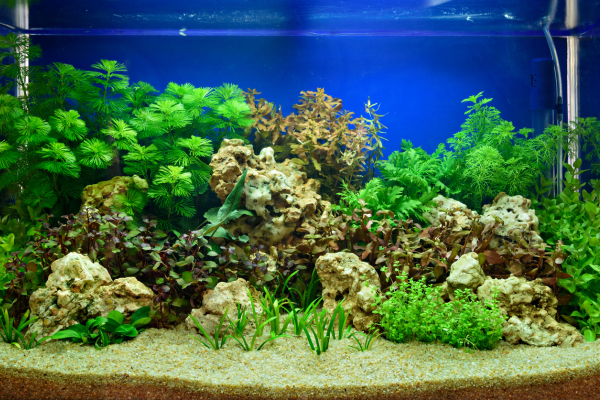
If you remember nothing else, remember this: arrange your plants in layers from back to front, tall to short. This single idea is responsible for most of what makes an aquascape look intentional rather than random.
Put your taller plants toward the back of the tank — things like Java fern that give height and a leafy backdrop. Place a medium centerpiece in the middle ground — an Anubias or a piece of Bucephalandra attached to a rock or piece of wood, something with presence that draws the eye. And keep the foreground low and open — a carpet of moss spilling across the front, with a little bare substrate left visible.
That back-to-front, tall-to-short gradient instantly creates a sense of depth and order. It’s the difference between a layout that looks designed and one that looks like plants were dropped in at random. Master this one principle and you’re most of the way to a good-looking tank. The plants that make this easy are covered in detail in the guide to the best low-tech plants for a shrimp tank.
Leave open space (the mistake beginners make)
The most common beginner instinct is to fill every square inch with plants, packing the tank wall to wall because more plants must mean a better scape. It’s the opposite. Crammed tanks look cluttered and busy, and they leave nowhere for the eye to rest.
The fix is to deliberately leave some open space — a patch of clean substrate at the front, a bit of breathing room around your centerpiece. That negative space is what makes the planted areas stand out, and it gives the whole layout a calm, intentional feel. It also has a practical bonus for shrimp keeping: open substrate at the front is where you’ll most easily watch your shrimp grazing, which is the whole point of a desk tank.
Resist the urge to fill everything. A little emptiness is a design feature, not a gap to plug.
Using hardscape as your foundation
Here’s a low-tech secret that doubles as a design tool: most of your plants attach to rocks and wood rather than rooting in the substrate. That means your hardscape — a nice rock, a piece of driftwood — isn’t just decoration, it’s the literal structure your scape is built on.
Start your layout by placing the hardscape first, before plants. A single characterful piece of driftwood or one well-chosen rock gives the tank a focal point and a sense of natural structure. Then you attach your Anubias, moss, and Java fern to that hardscape, letting the plants grow over and around it. The result looks organic and established, like plants colonizing a natural feature, because that’s essentially what’s happening.
In a small tank, you don’t need much — often a single piece of driftwood or one or two rocks is plenty. Restraint reads as elegance here. One striking piece beats a crowded pile of rocks.
A simple layout you can copy
If you want a concrete starting point rather than principles, here’s a foolproof desk-tank layout:
Place one piece of driftwood slightly off-center — not dead in the middle, because a little asymmetry looks more natural. Attach an Anubias near the base of the wood as your centerpiece. Wedge or tie some Java moss onto the lower parts of the wood and let it trail. Add a few Java fern toward the back corner for height. Leave the front third of the tank as open substrate. That’s it — a complete, balanced, great-looking scape using four easy plants and one piece of wood.
This layout works because it follows everything above: hardscape foundation, tall-to-short layering, a clear centerpiece, and open foreground space. You can vary the plants and the wood, but the skeleton holds up beautifully.
Let it grow in — patience finishes the job
Here’s the part that surprises people: a freshly aquascaped tank looks sparse and a little disappointing. The moss is thin, the Anubias has only a few leaves, the wood looks bare. Don’t judge your work on day one.
Aquascaping a low-tech tank is as much about patience as placement. Over the following weeks and months, the moss thickens and spreads over the hardscape, the Anubias throws new leaves, the Java fern fills out, and the whole scene knits together into the lush little world you were picturing. The layout you build on setup day is really just the framework; time and growth complete it. Some of the best-looking shrimp tanks simply started simple and were given months to mature.
So resist the urge to keep fiddling and adding more. Set up a clean, well-layered layout, then let it grow into itself.
The bottom line
Aquascaping a desk shrimp tank is far easier than the hobby’s intimidating reputation suggests. Build on a single piece of hardscape, layer your plants tall-to-short from back to front, choose one clear centerpiece, and deliberately leave open space at the front. Use the easy low-tech plants your shrimp want anyway, keep it simple, and then give it time to grow in.
You don’t need talent or expensive gear — just a few principles and a little patience. Start with the right plants, and the layout almost takes care of itself; you’ll find them all in the guide to the best low-tech plants for a shrimp tank.
