
Plants are where a shrimp tank stops being a box of water and starts being something you actually want to look at. They’re also doing real work — soaking up waste, growing the biofilm your shrimp graze on, and giving baby shrimp somewhere to hide. The good news for a low-tech desk tank is that the best shrimp plants are also the easiest ones. No CO₂, no fancy lights, no green thumb required.
I’ve killed my share of demanding plants. This list is the opposite of that — the ones that have never let me down, ranked roughly by how foolproof they are.
What “low-tech plant” actually means
A low-tech plant is one that grows without injected CO₂ and under modest lighting. That rules out the carpeting plants and red showpieces you see in competition aquascapes — those need high light and CO₂, and in a low-tech tank they melt or get strangled by algae.
What’s left is a group of slow, tough, undemanding plants that happen to be perfect for shrimp. Shrimp don’t care about a manicured carpet. They care about surfaces to graze and cover to hide in, and these plants deliver both while asking almost nothing of you.
There’s also a happy accident here: slow-growing plants pull nutrients slowly, which means less algae fuel and less trimming. In a low-tech tank, slow is a feature, not a flaw.
The shrimp-tank essentials
1. Java Moss — the one you cannot skip
If you buy a single plant for a shrimp tank, make it Java moss. It’s the most useful plant in the hobby for shrimp keepers and it’s nearly impossible to kill.
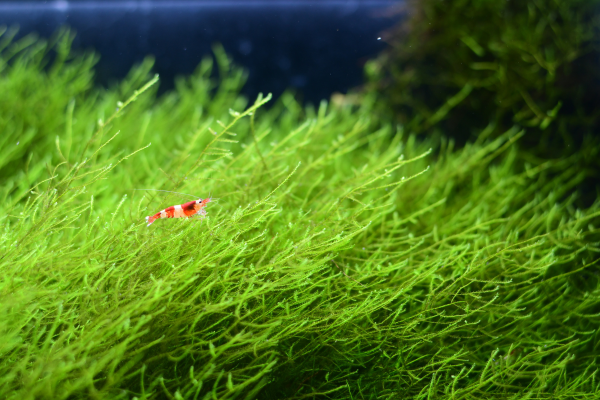
Why it’s perfect: that dense, tangled structure traps biofilm and detritus, which is exactly what shrimp graze on all day. It’s also the best baby-shrimp shelter there is — the tiny shrimplets vanish into it and feed safely. You’ll routinely see your colony pile onto a clump of moss like it’s a buffet, because it is.
It needs no substrate (just tie or wedge it onto a rock or piece of wood), no CO₂, and barely any light. It grows in almost any conditions. The only “maintenance” is trimming it when it gets too big. For a shrimp tank, this plant is non-negotiable.
2. Anubias — the indestructible centerpiece
Anubias (usually Anubias nana or nana ‘petite’ for a nano tank) is a slow-growing plant with thick, dark green leaves that look great and shrug off neglect. Those broad leaves are also prime real estate — biofilm grows on them and shrimp graze the surface constantly.
The one rule with Anubias: never bury the rhizome (the thick horizontal stem the leaves grow from). Bury it and it rots. Instead, glue or tie it to a rock or wood and let the roots find their own way. Do that and it’ll live for years with zero effort. It’s the plant I recommend for the “centerpiece” spot in a desk tank.
3. Java Fern — easy height and texture
Java fern is the other classic “attach it and forget it” plant. Like Anubias, it grows from a rhizome you fasten to hardscape rather than plant in substrate — bury it and it’ll rot. It gives you taller, leafier structure for the background of even a small tank, and it tolerates low light happily.
It propagates by growing little plantlets right on its older leaves, which you can detach and re-attach elsewhere — a free, slightly magical way to fill out the tank over time.
4. Bucephalandra — the slightly fancier option
If you want something a touch more special without leaving the easy category, Bucephalandra (“Buce”) is your plant. Same care as Anubias — attach the rhizome to hardscape, low light, no CO₂ — but with smaller leaves, often with a beautiful blue-green sheen and tiny flowers. It’s slow even by low-tech standards, which makes it tidy and algae-resistant. Shrimp love grazing the leaves.
5. Floating plants — for shade and water quality
Floating plants like Salvinia or Frogbit pull nutrients straight out of the water column through fast-growing roots, which helps starve out algae. Those dangling roots are also a favorite shrimp grazing spot, and the shade they cast can actually reduce algae on the tank below.
One caution: in a small tank they multiply fast and can cover the whole surface, blocking light and gas exchange. Thin them out regularly. Used with a little discipline, they’re a genuine water-quality asset.
How to use them: simple aquascaping for a desk tank
You don’t need a design degree. A layout that looks good and works for shrimp follows a couple of easy ideas.
Think in three zones. Taller plants (Java fern) toward the back, a centerpiece (Anubias or Buce on a rock) in the middle, and moss spilling across the front and over the hardscape. Leave a little open substrate at the front — it gives the eye somewhere to rest and lets you actually watch the shrimp.
Build on hardscape, not in the substrate. Notice that almost every plant here attaches to a rock or piece of wood rather than rooting in the ground. That’s the low-tech secret — it means your choice of substrate barely matters, and rearranging is as easy as moving a rock.
Let it grow in. A freshly planted tank looks sparse. Give it a month or two and the moss thickens, the Anubias throws new leaves, and it starts to look like the lush little scene you imagined. Patience again — the theme of this whole hobby.
A quick word on driftwood
A small piece of driftwood isn’t a plant, but it belongs in this conversation. It’s the perfect anchor for moss, Anubias, and Java fern all at once, and as it ages it grows biofilm that shrimp adore. New driftwood often grows a harmless white fungal film for the first couple of weeks — shrimp will graze it and it disappears on its own. Don’t panic, don’t scrub it.
What to avoid
- CO₂-demanding carpeting plants (like dwarf hairgrass or Monte Carlo) — they’ll fail in low light without CO₂ and just frustrate you.
- Bright red stem plants — almost all need high light and CO₂ to stay red; in a low-tech tank they go green and leggy or melt.
- Anything sold as “advanced” or “high-tech.” The label is doing you a favor. Believe it.
The takeaway
For a low-tech shrimp tank, the best plants are the easy ones, and that’s genuinely lucky. Start with Java moss — it’s the workhorse. Add an Anubias or a piece of Bucephalandra on a rock as a centerpiece, some Java fern for height, and maybe a little floating plant for water quality. Attach everything to hardscape, give it modest light, and then mostly leave it alone.
Do that and you’ll have a green, living desk tank that grows the food your shrimp eat, hides the babies they produce, and looks better every month — all without a single piece of high-tech gear.
