
If you could only put one plant in a shrimp tank, it should be moss — and it’s not a close decision. Among all the plants available to a low-tech shrimp keeper, moss stands alone as the single most useful, and once you understand why, you’ll never set up a shrimp tank without it. It’s the plant that does the most jobs, asks for the least, and that your shrimp will genuinely love. Let me explain exactly what makes it so perfect.
It’s a 24-hour grazing buffet
The number one reason moss is perfect for shrimp comes down to how shrimp eat. Shrimp are grazers — they spend their entire day picking at surfaces, harvesting biofilm, the invisible layer of microorganisms that grows on everything in an aquarium. And moss, with its dense, intricate, tangled structure, has an enormous amount of surface area, which means it grows and traps far more biofilm than a smooth leaf ever could.
The practical result is that a clump of moss becomes a round-the-clock buffet for your shrimp. They climb all over it, working through every strand, harvesting food you never have to add. Watch a shrimp tank with a healthy clump of moss and you’ll almost always see shrimp piled onto it, grazing contentedly — it’s one of the most characteristic and satisfying sights in the hobby. That tangled structure also traps tiny bits of food and detritus drifting through the water, adding even more for the shrimp to find.
In short, moss feeds your shrimp passively, all day, for free.
It’s the best nursery for baby shrimp
The second reason is arguably even more important: moss is the single best place for baby shrimp to survive and grow. When your colony breeds — and a healthy Neocaridina colony breeds enthusiastically — the babies are tiny, nearly microscopic, and extremely vulnerable in their first days and weeks.
Moss solves this perfectly. That dense tangle gives the shrimplets endless places to hide, sheltering them while they’re at their most fragile. Just as crucially, the same biofilm that feeds the adults is the ideal first food for babies too small to do much else — they can graze the moss they’re hiding in without ever venturing into open water. Shelter and food in one plant, exactly where the babies need them.
For many keepers, the difference between a colony that grows and one that mysteriously never seems to increase comes down to whether the babies have enough cover to survive. Moss provides that cover better than anything else, which is why a tank intended to grow a colony should always have a generous amount of it.
It’s almost impossible to kill
The third reason moss is perfect is that it’s the easiest plant you’ll ever keep, which matters enormously in a low-tech tank. Moss needs no special substrate to root in, no CO₂, and barely any light. It grows in conditions that would kill demanding plants, tolerating low light and neglect with ease.
You don’t even plant it in the traditional sense — you simply attach it to a rock or piece of driftwood, or just wedge it somewhere, and it grows. There’s no fussing, no special care, no failure mode beyond letting it get too big. For a beginner especially, this is a gift: the most useful plant for your shrimp is also the one you’re least likely to mess up. It thrives precisely in the low-tech conditions your shrimp tank already provides.
It makes the tank beautiful, too
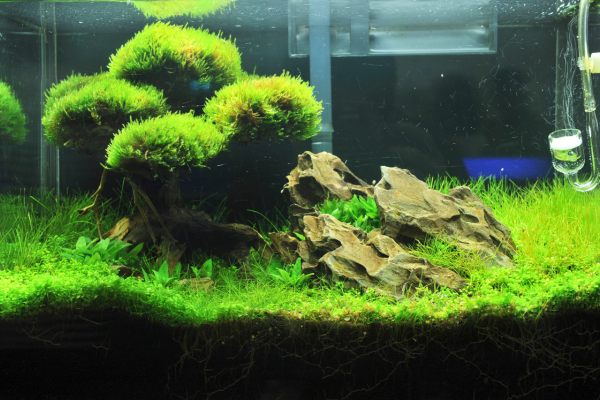
Beyond all its practical virtues, moss simply looks wonderful in a shrimp tank. It brings a soft, natural, established feel — lush green spilling over rocks and wood, the look of a mature, living scene rather than a sterile box. As it grows in over weeks and months, it knits the hardscape together and gives the whole tank that mossy, woodland-stream character that makes nano shrimp tanks so appealing.
It’s also wonderfully versatile in aquascaping. You can carpet the foreground with it, let it trail down a piece of driftwood, attach it to a rock as a centerpiece, or let it form a wall — it adapts to whatever look you’re going for. Few plants combine this much practical usefulness with this much visual charm.
The popular types of moss
“Moss” covers several varieties, and you don’t need to overthink the choice. Java moss is the classic and most widely available, and it’s the one most keepers start with for good reason — it’s hardy, fast, forgiving, and cheap. It’s the default recommendation and an excellent one.
Other varieties like Christmas moss, Flame moss, and Weeping moss offer slightly different appearances and growth patterns for those who want a particular aesthetic, but they share the same shrimp-friendly virtues. For a first tank, Java moss is the sensible, foolproof starting point, and you can always experiment with others later once you’ve seen how well moss works.
How to use moss in your tank
Using moss couldn’t be simpler. Attach a portion to a rock or piece of driftwood — you can tie it with thread or fishing line, or use a little aquarium-safe glue — and place it where you’d like it. Over time it grows and spreads to cover whatever it’s attached to, creating that lush mossy look. You can also simply let a clump rest in the tank, though attaching it keeps things tidier.
Maintenance is minimal: the only real task is trimming it back when it grows larger than you want, which also gives you spare moss to start another patch or share. Avoid burying moss under substrate, and give it a spot with at least modest light and gentle water flow so it stays clean and healthy. That’s genuinely all there is to it.
The bottom line
Moss is the perfect plant for a shrimp tank because it does what shrimp need better than anything else: it’s a constant grazing buffet of biofilm, the safest nursery and first food for baby shrimp, nearly impossible to kill in low-tech conditions, and beautiful on top of all that. If you set up a shrimp tank with only one plant, make it moss — preferably a generous amount of Java moss — and your colony will graze it, breed in it, and thrive because of it.
It’s the cornerstone plant of shrimp keeping, and it earns a place in every tank. For how it fits alongside the other easy plants worth keeping, see the guide to the best low-tech plants for a shrimp tank.
