
One of the biggest sources of confusion for new aquarists is CO₂ — specifically, the worry that growing live plants requires an expensive, complicated pressurized CO₂ system. It’s an understandable fear, because so much of the aquascaping content online revolves around high-tech, CO₂-injected tanks. But here’s the liberating truth: a whole category of beautiful, hardy plants grows perfectly well without any added CO₂ at all, and these “low-tech” plants happen to be exactly the ones a shrimp tank wants. You can have a lush, green, living tank with zero CO₂ equipment.
Let me explain why CO₂ matters for some plants but not others, and walk you through the plants that thrive without it.
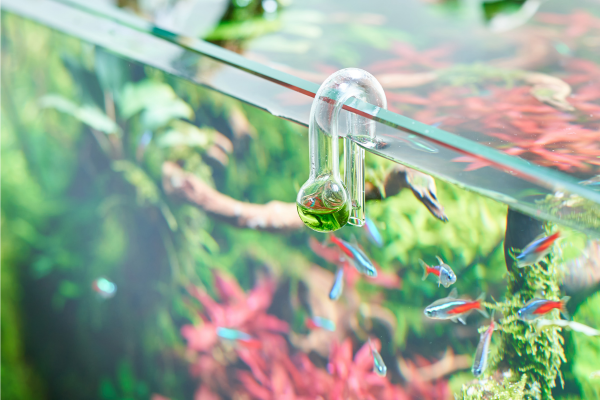
Why some plants “need” CO₂ and others don’t
To make sense of this, it helps to understand what CO₂ actually does. Plants use carbon dioxide as a building block for growth through photosynthesis. Some plants are fast, demanding growers that consume CO₂ faster than it naturally occurs in tank water — for these, adding pressurized CO₂ lets them grow vigorously and show their best colors and forms. Without it, they struggle, grow poorly, or simply melt away.
But many plants are slow, undemanding growers perfectly content with the small amount of CO₂ that’s naturally present in any aquarium — produced by fish, shrimp, bacteria, and the general life of the tank. These plants never needed the extra; they evolved to grow steadily on what’s naturally available. They are the “low-tech” plants, and they’re the foundation of any tank run without CO₂ equipment.
So the dividing line isn’t “plants that need CO₂ versus plants that don’t” in some absolute sense — it’s demanding fast growers versus easygoing slow growers. For a shrimp tank, you want the easygoing ones, and there’s a lovely selection of them.
The slow-growth bonus for shrimp tanks
Before the list, here’s a point worth appreciating: the slow growth of low-tech plants isn’t a drawback in a shrimp tank — it’s an advantage. Fast-growing CO₂-hungry plants demand lots of light and nutrients, and that same abundance tends to fuel algae, which is a common headache in high-tech tanks. Slow-growing low-tech plants sip nutrients gently, giving algae far less to feed on. The result is a calmer, more stable, lower-maintenance tank with less trimming and less algae trouble. For a relaxed desk shrimp tank, slow and steady is exactly what you want.
The best CO₂-free plants for a shrimp tank
Here are the reliable low-tech plants that grow without any added CO₂, all of which are also excellent for shrimp.
Java moss is the champion. It grows in almost any conditions with no CO₂, low light, and no substrate, and it’s the single most useful plant for shrimp — a grazing surface and a baby nursery in one. Every CO₂-free shrimp tank should have it.
Anubias is a tough, slow-growing plant with thick dark green leaves that thrives without CO₂. It attaches to rocks and wood rather than rooting in substrate, and its broad leaves make excellent grazing surfaces for shrimp. The smaller varieties like Anubias nana are ideal for a nano tank. Just remember never to bury its rhizome, or it’ll rot.
Java fern is another attach-to-hardscape plant that grows happily without CO₂ in low light. It provides leafy height for the background of a tank and propagates by growing little plantlets on its own leaves. Like Anubias, its rhizome must stay above the substrate.
Bucephalandra is a slightly fancier option that’s still fully low-tech — same care as Anubias, attaching to hardscape and growing slowly without CO₂, but with smaller leaves that often carry a beautiful blue-green sheen. Shrimp love grazing its leaves, and its slowness makes it tidy and algae-resistant.
Floating plants like Salvinia and Frogbit grow without CO₂ and pull nutrients straight from the water, helping to starve out algae. Their dangling roots are a favorite shrimp grazing spot, and the shade they cast can reduce algae below. They do multiply quickly, so thin them out periodically.
Together, these plants let you build a complete, layered, lush tank — moss and floating plants doing their work, Anubias and Buce as centerpieces, Java fern for height — all without a molecule of added CO₂.
What to avoid: the CO₂-dependent plants
Just as useful as knowing what works is knowing what to steer clear of, because buying the wrong plant leads to frustration and failure.
Avoid demanding carpeting plants like dwarf hairgrass and Monte Carlo, which need high light and CO₂ to form those lush green carpets — without CO₂ they grow leggy, struggle, and often melt. Avoid most bright red stem plants, whose vivid colors almost always depend on high light and CO₂; in a low-tech tank they tend to turn green, grow poorly, or disintegrate. As a general rule, anything sold and marketed as “high-tech,” “demanding,” or “advanced” is telling you plainly that it’s not for a CO₂-free tank. Believe the label and skip it.
The good news is that avoiding these costs you nothing, because the low-tech plants are not a compromise — they’re genuinely beautiful and far better suited to a shrimp tank anyway.
You really don’t need CO₂
It’s worth saying plainly, because the high-tech corner of the hobby can make it feel otherwise: a CO₂ system is completely optional, and for a low-tech shrimp tank it’s not just unnecessary but arguably undesirable. The fast growth it drives demands more light, more nutrients, more trimming, and more vigilance against algae — the opposite of the calm, low-maintenance tank most shrimp keepers want.
By choosing low-tech plants, you sidestep all of that. You get a green, healthy, living tank with less equipment, less cost, less maintenance, and fewer problems. The plants thrive on the natural CO₂ the tank already produces, your shrimp graze and breed among them, and you spend your time enjoying the tank rather than managing machinery.
The bottom line
You don’t need CO₂ to grow a beautiful planted shrimp tank. A whole category of hardy, slow-growing low-tech plants — Java moss, Anubias, Java fern, Bucephalandra, and floating plants — thrives on the natural CO₂ already present in any aquarium, and these are precisely the plants that suit shrimp best. Skip the demanding carpets and red stems that depend on CO₂, embrace the easy plants, and you’ll have a lush tank with none of the cost or complexity.
Low-tech isn’t the budget compromise; for a shrimp tank, it’s the better way to do it. For the full rundown of these plants and how to use them, see the guide to the best low-tech plants for a shrimp tank.
