
Water changes are one of those maintenance tasks that new shrimp keepers tend to either overthink or get subtly wrong, and with shrimp the details matter more than they do with fish. The short answer is that a small water change about once a week works well for most shrimp tanks — but how you do it matters just as much as how often, because shrimp are far more sensitive to sudden changes than fish are. Get the rhythm and the technique right and water changes become a quiet, easy part of keeping your tank healthy.
Let me explain how often, how much, and most importantly how to do them safely.
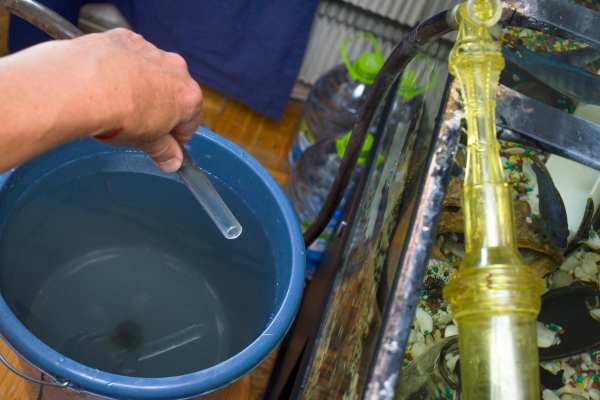
Why water changes matter
First, the why. Even in a well-cycled tank, the nitrogen cycle leaves behind nitrate as its end product — relatively harmless in small amounts, but it accumulates over time, and you don’t want it building up indefinitely. Water changes are how you remove that accumulated nitrate and refresh the water, keeping conditions clean and stable.
Beyond nitrate, water changes also replenish the minerals shrimp need (particularly for molting) and dilute any other gradual build-ups in the water. They’re the routine reset that keeps a tank in good long-term health. So they’re worth doing — the question is just finding the right frequency and amount, and the right technique for shrimp specifically.
How often and how much
For most shrimp tanks, a water change of around 10 to 20% once a week is a good baseline. That’s a modest, gentle amount on a regular schedule, and it suits shrimp far better than large, infrequent changes.
The key word there is small. With shrimp, you specifically want frequent small changes rather than occasional big ones, and the reason ties directly to shrimp biology. A small 10–20% change barely shifts the tank’s overall parameters, so it refreshes the water without shocking your shrimp. A large 50% change, by contrast, swings the parameters significantly all at once — and that sudden swing is exactly what stresses and can kill shrimp. Small and steady is the rule.
This is the opposite instinct from “more must be better.” With shrimp, less water changed more gently is better than more water changed dramatically. A consistent small weekly change keeps everything stable, which is the whole game.
Why shrimp need the gentle approach
It’s worth dwelling on why shrimp demand more care here than fish, because understanding it makes you do it right by instinct. Throughout shrimp keeping, the central principle is that shrimp tolerate stable, slightly-imperfect conditions far better than they tolerate sudden change. Their small size and sensitivity mean a rapid shift in temperature, pH, or mineral content stresses them quickly.
A big water change is one of the most common ways beginners accidentally create exactly that kind of sudden shift — fresh water of a different temperature and chemistry flooding in all at once. By keeping changes small and matching the new water carefully (more on that next), you avoid the swing entirely. The gentle approach isn’t fussiness; it’s working with shrimp biology instead of against it.
How to do a water change safely
Technique is where shrimp water changes really differ from fish tanks, so here’s how to do it right.
Always dechlorinate the new water. Tap water contains chlorine or chloramine that’s harmful to shrimp and to the beneficial bacteria in your tank. Treat the replacement water with a dechlorinator before it goes in, every single time. This is non-negotiable.
Match the temperature. The new water should be close to the tank’s current temperature. Pouring in water that’s noticeably colder or warmer creates a temperature swing — precisely the kind of shock to avoid. A little attention here goes a long way.
Add the new water slowly and gently. Don’t dump it in. Pouring slowly, ideally onto a plate, a rock, or your hand to break the flow, prevents both a parameter shock and a blast that disturbs your substrate and plants. Gentle and gradual is the theme.
Watch out for shrimp when removing water. When siphoning water out, be careful not to suck up shrimp — especially tiny babies, which are easily drawn into a siphon. Many keepers put a piece of sponge or a fine mesh over the siphon intake to keep shrimp safe, or simply siphon carefully from an area where shrimp aren’t congregating.
Done this way — dechlorinated, temperature-matched, added slowly, shrimp protected — a water change refreshes the tank without the slightest stress to your shrimp.
Topping off vs. water changes
One distinction that confuses beginners: topping off is not the same as a water change. As water evaporates from your tank, the level drops, and you replace what evaporated with fresh dechlorinated water — that’s topping off. But topping off only replaces water that left as vapor, which doesn’t remove any nitrate or accumulated dissolved solids, so it doesn’t do the job of a water change.
In fact, only topping off and never doing real water changes can slowly concentrate minerals and dissolved solids over time, because evaporation leaves those behind while you keep adding more. So do both: top off to maintain the water level as it evaporates, and do your regular small water changes to actually refresh the water and remove nitrate. They’re two different tasks serving two different purposes.
Adjusting to your tank
The 10–20% weekly guideline is a starting point, not a rigid law, and an established tank tells you whether it’s right. The real arbiter is your test kit: if nitrate is staying nicely low, your routine is working. If nitrate creeps up, you might change a bit more often or a bit more volume. A heavily planted tank with a light shrimp load may need less; a more stocked tank may need a touch more.
The point is to keep conditions stable and nitrate low with the gentlest routine that achieves it. Once you find your tank’s rhythm, water changes become a quick, almost meditative weekly habit rather than a chore.
The bottom line
For most shrimp tanks, a small water change of 10 to 20% once a week keeps the water fresh and nitrate low without stressing your shrimp. The golden rule is small and frequent over large and occasional, because shrimp tolerate stability far better than sudden change. Always dechlorinate and temperature-match the new water, add it slowly, and protect your shrimp from the siphon — and remember that topping off evaporated water is a separate task from a real water change, so do both.
Get the rhythm and technique right and water changes are one of the easiest parts of shrimp keeping. They’re one piece of the wider care routine covered in full in the Neocaridina shrimp care guide.
