
Picking your first tank feels like it should be the easy part, and then you start looking and there are rimless cubes and bowfronts and all-in-one kits and bare glass boxes, and suddenly you’re three tabs deep wondering if you need a filter built into the back. Let me simplify all of it. For a low-tech shrimp tank on a desk, the right choice comes down to a handful of things that actually matter — and a lot of features you can safely ignore.
This isn’t about which brand to buy. It’s about understanding what makes a tank good for shrimp on a desk, so you can walk into any store or scroll any listing and judge it yourself.
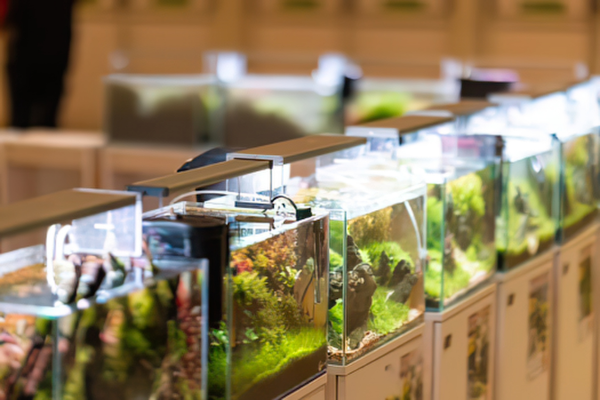
Bigger is easier — the one rule that surprises beginners
The most counterintuitive truth in this hobby: a slightly bigger tank is easier to keep than a tiny one. It feels backwards. Surely less water is less work?
It’s the opposite. Water volume is stability. In a larger body of water, temperature shifts slowly, and any mistake — a bit too much food, a missed water change — gets diluted across more water. In a tiny tank, everything swings fast and hard. A 2-liter “shrimp bowl” looks adorable and is genuinely harder to keep alive than a calm 10-liter tank.
So the practical advice: get the largest tank that still fits comfortably on your desk. For most desks that lands somewhere around 8 to 20 liters (roughly 2 to 5 gallons). Big enough to be forgiving, small enough to belong on a desk. If you’re choosing between two sizes, go up.
Shape matters more than you’d think
Tanks come in different proportions, and for a desk it’s worth a moment’s thought.
Footprint beats height. Shrimp live on surfaces — the substrate, the plants, the glass — not in open water like fish. A tank that’s wider and shallower gives them more floor and more grazing area than a tall, narrow tank of the same volume. A long, low tank is also easier to light, easier to reach into, and frankly looks better on a desk than a tall column.
Rimless tanks look cleaner. Tanks without the plastic frame around the top (rimless) have become popular for a reason — they look modern and let you see the shrimp clearly. They’re a little more fragile at the edges, but for a desk display they’re lovely. The framed kind is tougher and cheaper; neither is wrong.
Curved or “bowl” fronts distort the view. They look interesting empty, but the curved glass warps how the shrimp look. A flat front gives you the clearest view, which matters a lot when your whole point is watching them up close.
All-in-one kit vs. building it yourself
You’ll face this choice early: buy a kit with everything included, or assemble the pieces yourself.
Kits bundle the tank, a light, and a filter in one box. The appeal is obvious — less decision-making, everything fits together. The catch for shrimp keepers is that the included filter is often a powered intake that can suck up babies, and the included light is sometimes weak. Kits are convenient, but check what filtration they come with.
Building it yourself means a bare tank plus the pieces you choose — and for shrimp, that usually means a gentle sponge filter instead of whatever a kit includes. It’s barely more effort, it’s often cheaper, and you end up with gear that actually suits shrimp rather than gear that suits the manufacturer’s box. For a low-tech shrimp tank, I lean toward building it yourself for exactly this reason: the filtration choice matters, and you want it to be yours.
Neither path is wrong. If “everything in one box” is what gets you to actually start, a kit is fine — just plan to swap or supplement the filter.
What to actually look for
When you’re evaluating any nano tank for shrimp, run through this short mental checklist:
- Volume in the 8–20 L range — forgiving but desk-friendly.
- More footprint than height — surface area is what shrimp use.
- A flat front — for the clearest view.
- Gentle filtration, or room to add it — a sponge filter is the shrimp-safe standard; avoid strong intakes that endanger babies.
- A lid or cover option — shrimp rarely jump, but it cuts evaporation (important in a small tank) and keeps dust out.
- Glass over acrylic, if you have the choice — glass resists scratching, and you’ll be cleaning the front often.
That’s the whole list. Notice what’s not on it: brand names, high-tech features, gadgets. None of that matters for what you’re doing.
What you can safely ignore
The market loves selling features. For a low-tech desk shrimp tank, here’s what you don’t need and shouldn’t pay extra for:
- Built-in CO₂ readiness — you’re low-tech; you’re not using CO₂.
- Powerful “high-flow” filtration — shrimp want gentle, not a current that flings them around.
- Elaborate multi-stage lighting — your low-tech plants are happy with modest light.
- Tiny “starter bowls” marketed as beginner-friendly — they’re the hardest to keep stable, despite the marketing.
A simple glass box of the right size will outperform an expensive gadget-laden tank for this purpose. Spend your attention on size and shape, not features.
A note on placing it on the desk
Once you’ve chosen the tank, two placement things decide how well it goes:
Weight. Water is heavy — figure roughly one kilogram per liter, plus substrate. A 15-liter tank is pushing 18+ kg full. Any normal desk handles that, but put it on a solid, flat section, not an overhang or a wobbly shelf, and ideally near a corner where the desk is best supported.
Light from windows. Keep the tank out of direct sunlight. A sunny spot swings the temperature and feeds relentless algae. Normal room light plus a small tank light is exactly what you want — bright enough to enjoy and grow easy plants, controlled enough to keep algae in check.
The honest bottom line
Choosing a nano tank for a desk is much simpler than the options make it look. Get a glass tank somewhere around 8 to 20 liters, wider than it is tall, with a flat front and gentle filtration — or the room to add it. Skip the bowls, skip the gadgets, and don’t let “all-in-one” convenience talk you into a filter that endangers baby shrimp.
The tank itself is honestly the least finicky decision in this hobby. Get something reasonable in the right size, and then put your real energy where it counts: cycling it properly and keeping the water stable. A plain, well-chosen box of glass with healthy water beats an expensive tank with rushed setup every single time.
Pick something simple, set it up patiently, and let the shrimp make it interesting.
